I recently completed my very first art residency and I couldn’t be more proud, more excited, and more inspired! I wanted to share some behind-the-scenes thoughts. Especially for those of you who crave art opportunities like residencies, who struggle finding their place or next project. This is a good reminder that there are opportunities up for grab, right in your own backyard! So stop dreaming of greener pastures, and start right here, right now.
ON CREATING MY OWN OPPORTUNITY
For years, I’ve dreamed of applying for art residencies. I would read the descriptions, analyze the costs, peruse previous fellows, and identify the best fit. Then I would agonize, despair, cry, look at my work and think nobody wants this, I suck, this sucks, wah wah wah. And never did I end up applying to any residency.
A few months ago, I decided I could either continue crying about not having the art opportunities I wanted, or do something about it. And I realized: if I am going to invest into an art residency (it can be quite expensive), why leave it to chance? Why wait for someone else to pick me? Why not just create my own opportunity?
Around that time I visited the Natural History Museum in Los Angeles. They were hosting a special day about wolf conservation and featuring the wonderful work of Ronan Donovan. At a table, there was the articulated skeleton of an English Bulldog. I engaged in conversation with who turned out to be the mammals collection manager, Shannen Robson. She suggested I come visit the collection. My jaw dropped. Turns out, in Los Angeles, the museum will welcome any researcher, artist, anyone with an interest, to book a private visit of their collection and conduct projects. And Shannen takes this very seriously. “I am not the gatekeeper of this collection," she said, “I am just a facilitator. This collection belongs to the tax payers.”
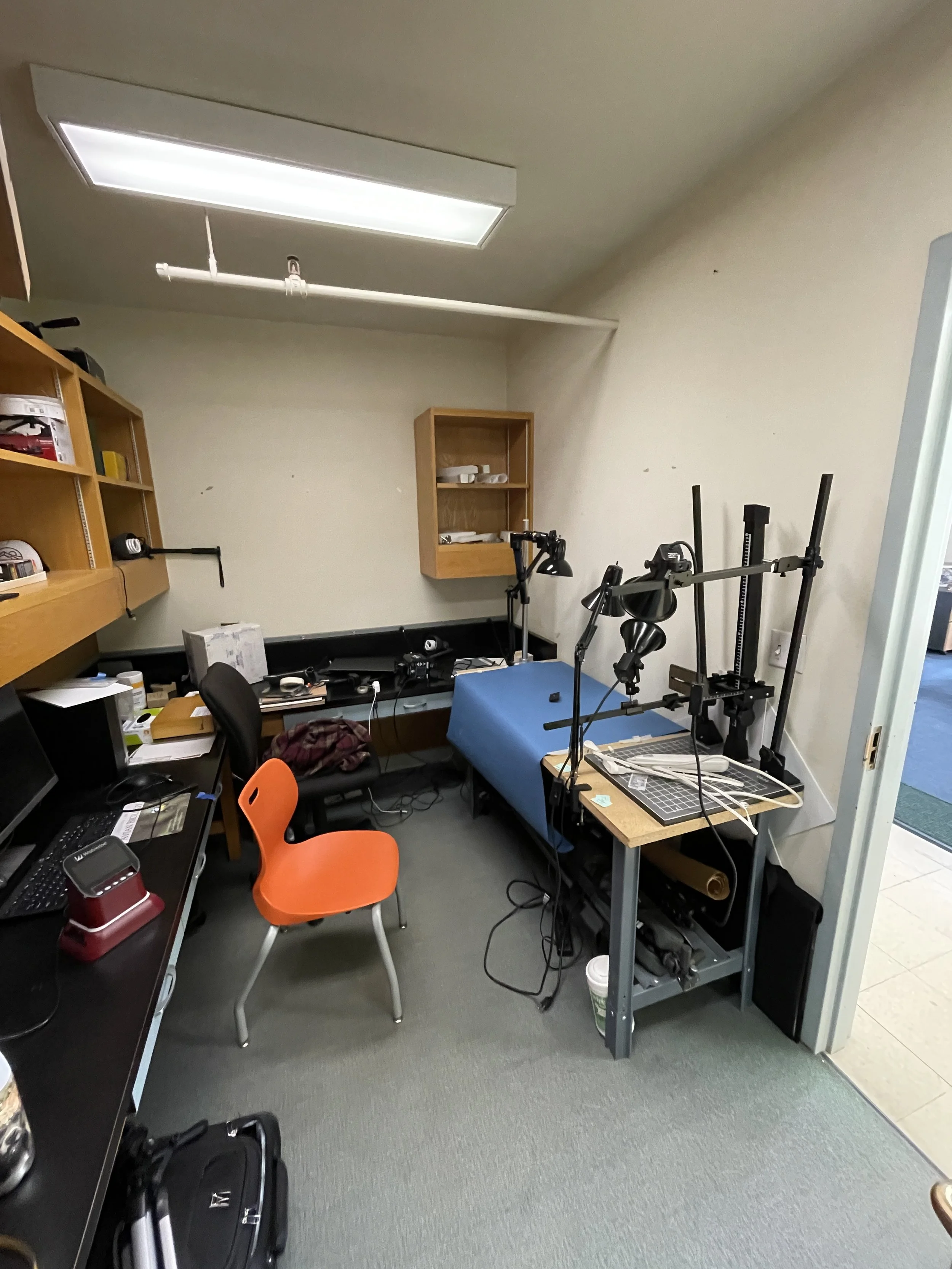
And just like that, I booked my very first art residency. For free. Shannen and I agreed I would come spend a week. I had a small desk and an imagery room at my disposal.
SITTING WITH THE DISCOMFORT
I had a rough idea of what I wanted to work on, but not a firm plan and certainly not enough to entertain a full week of work. On the first day of my residency, I resisted the urge to dive into my idea. First, I would spend a whole day without my camera, just taking the time to familiarize myself with the small–but mighty–dog collection of the museum. Sit with the discomfort of not knowing: would anything come out of this experience?
It took a lot of effort to soothe the imposter syndrome, the crying baby, the freaked out adult, and let the very excited little girl in me take the lead. After all, as a child I dreamed of becoming a paleontologist.
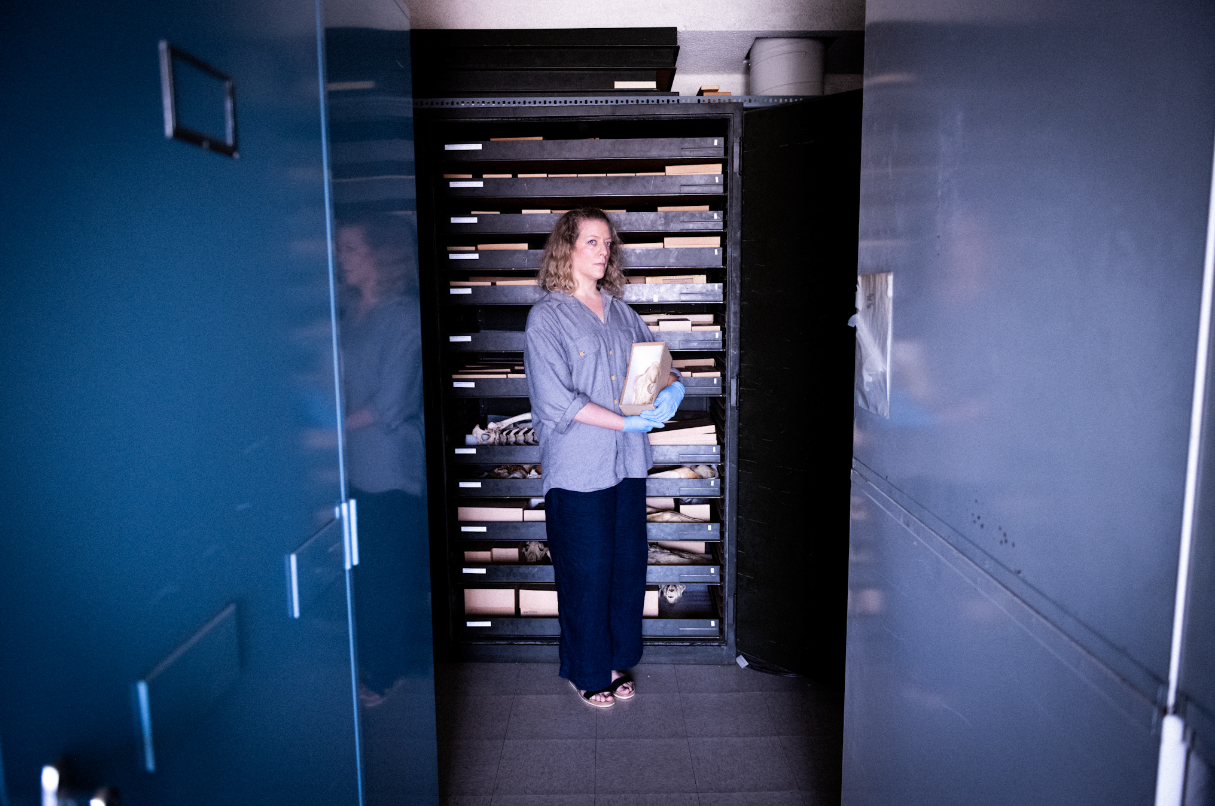
That’s me standing in front of the dog collection and holding a box containing a dog skull.

At the NHMLA, the dog collection fits into four small drawers, locked away in a metal cabinet. While the mammals department inherited the dog collection from the early days of the museum, it’s not something they are vested in as they focus on wildlife. In the drawers, all the dogs are archived in boxes to save space. A jumble of bones.
It took me a little while to dare touching them. The animal chaplain in me wrestled with ethical quandaries. These dogs did not choose this fate. I could feel the tension. Sure, these specimens allow scientists to make new discoveries (all the specimens are still actively used by scientists as needed), allow for more education and awareness, but these dogs never chose this fate. Unlike humans, they were never asked whether they’d like to donate their bodies to science…
THE LONE WOMAN… NOT SO LONE!
The first day, I looked at the records, matching each skull and skeleton to the few notes I could find in an old, handwritten catalog. I would note the specimen number, open the catalog and match it, then read who the donor was and where the specimen came from. Not a ton of information, but enough to get me started.
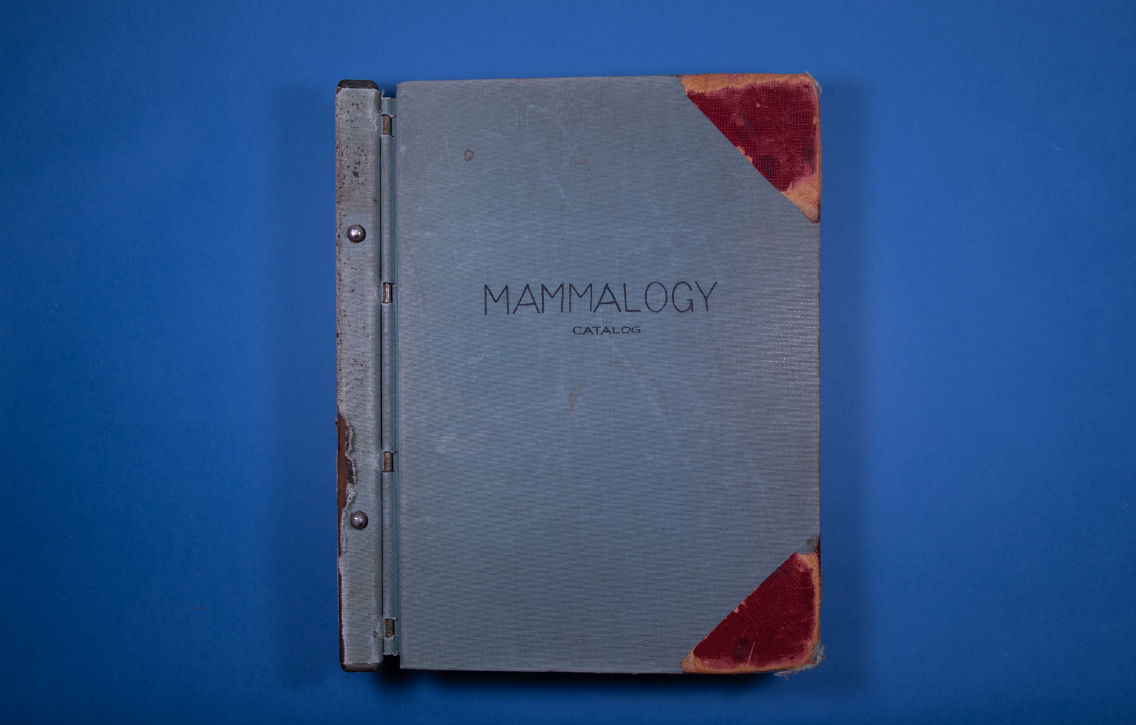
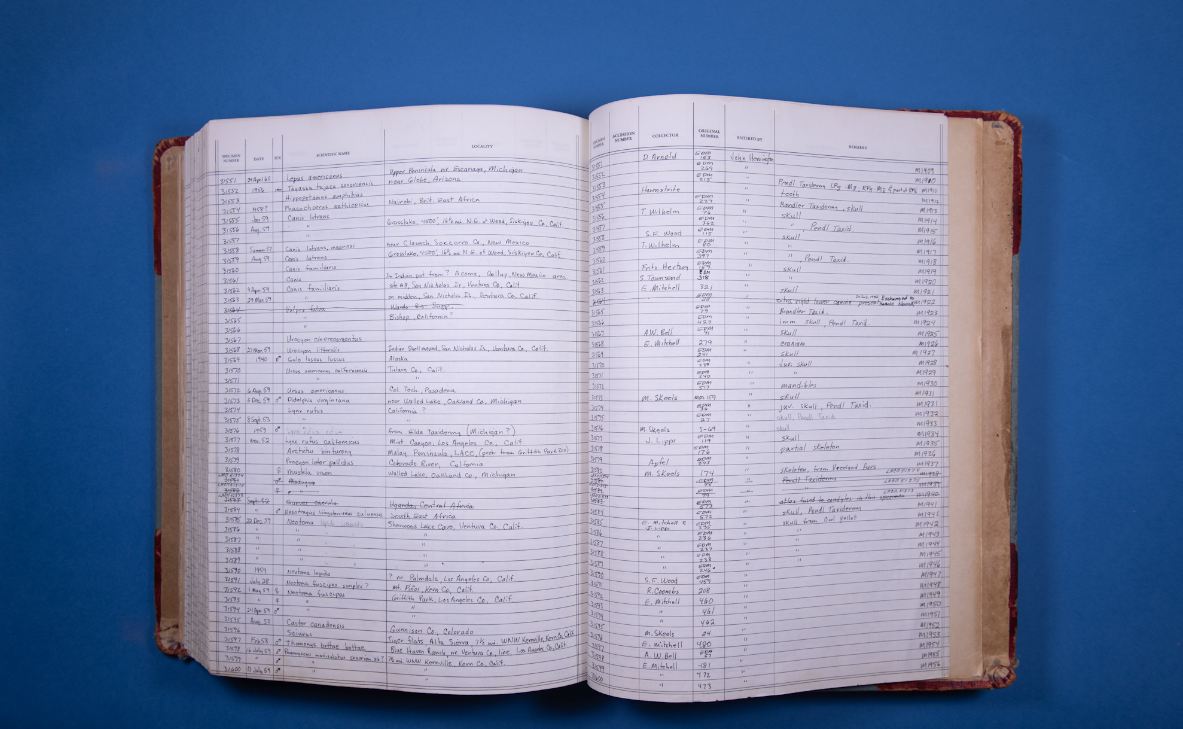
Most specimens entered the collection in the 1920s. Several stories gripped me. And it was a bit like doing detective’s work: following a lead, making hypotheses. Several skeletons were of brachycephalic (flat-faced) dogs and came from what appeared to be a veterinarian. It made sense as their deformed skulls and skeletons had huge scientific and educational value for a veterinarian I am sure. One was listed as a police dog, and I hope to find out more about his fate.
Then there were three old skulls originating from San Nicholas island. For some reason, I got curious about the island and started researching it. These days, the island–which is located off the coast of Southern California–belongs to the Navy and is closed to the public (it was actually considered for an atomic bomb test, many moons ago!). But before that, the island was at the crossroads of the otter fur trade, and inhabited by the Nicoleño, a people who lived there for 10,000 years. In the late 1800s, most were killed in a conflict with Russian fur traders. The few survivors were relocated to the mainland by missionaries. All, but one woman who never made the trip and remained on the island. Many stories and myths surround her, and because her name was never known, she was nicknamed the Lone Woman. The myth says that she remained alone on the island for 18 years, until she finally made the trip to the mainland (only to die of dysentery 7 weeks later). As a child you might have read Island of the Blue Dolphins, loosely inspired by her story.
Here I was, reading about the Lone Woman of San Nicholas, while holding a dog skull from that same island. And the thought dawned on me: she was never alone. I found a few records that mention dogs. The woman was indeed found with dogs. And the island counted 23 ritualistic burials of dogs. These skulls most likely come from those burials. Which gives them a whole other significance.
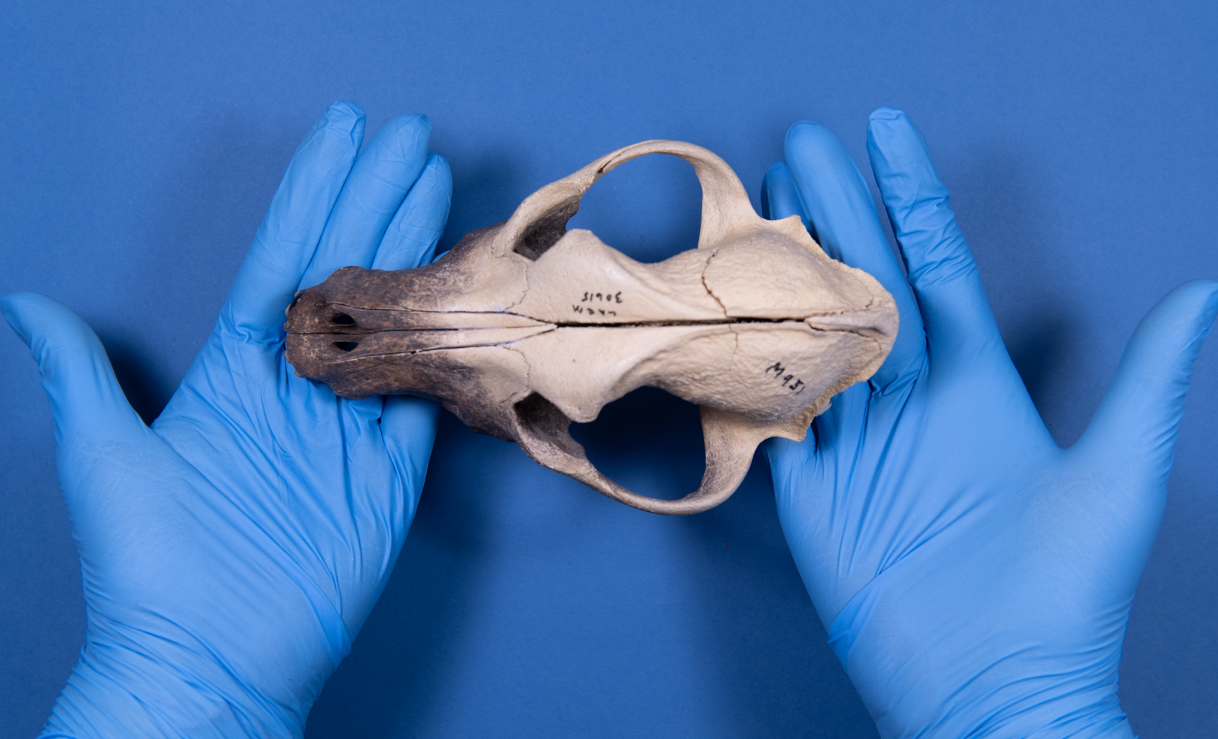
One of the San Nicholas Island’s dog skulls.
THE WALLPAPER DOGS
On my second day at the museum, I came in inspired and with my mind spinning from all I had learned about the Lone Woman, and all the unanswered questions I had.
I started taking photos and videos, and everything clicked. I got to work on a project I had dreamed of for years: creating a wallpaper pattern using the bones of brachycephalic dogs. Ok. Hear me out. I know how this sounds, but I promise there is a whole thought process here. Initially I was going to create these using x-rays, but it wasn’t working. Thanks to this residency, I was able to have access to real skeletons, of brachy dogs especially, which made this project possible at last. You can view the project on my website.
These wallpapers are inspired by arsenic-laced Victorian wallpapers, in which death and pretty are intertwined. Through my images, I reveal the skeletons of dogs bred with deformity, turning them into pretty motifs. During Victorian times, dog breeding exploded, and brachy dogs were much beloved. This is actually when the French Bulldog was invented (using the same ancestor as pit bulls: the bull-baiting bulldog!). It’s also a time when women wore tight corsets which made it difficult to breathe–the same way flat-faced dogs struggle. I see a lot of parallels between the forced domesticity of Victorian women, and the treatment of dogs–especially brachy dogs. It all comes together, trust me!
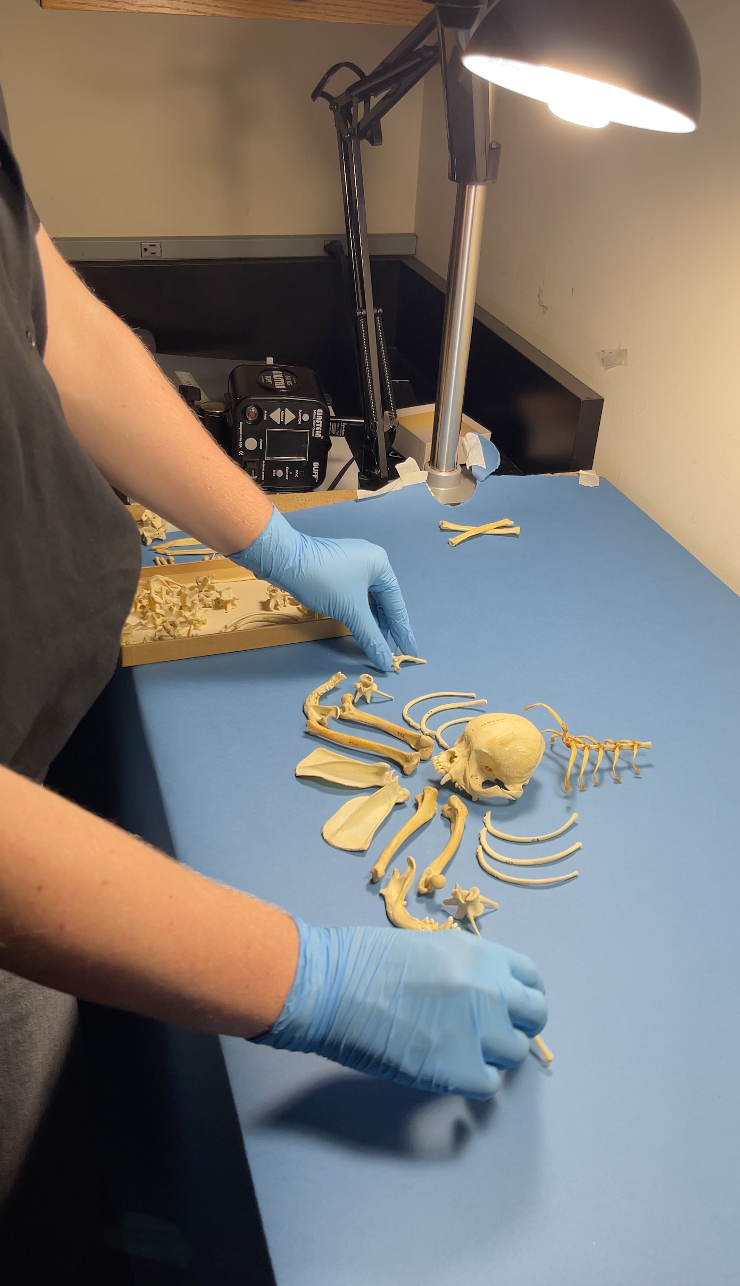
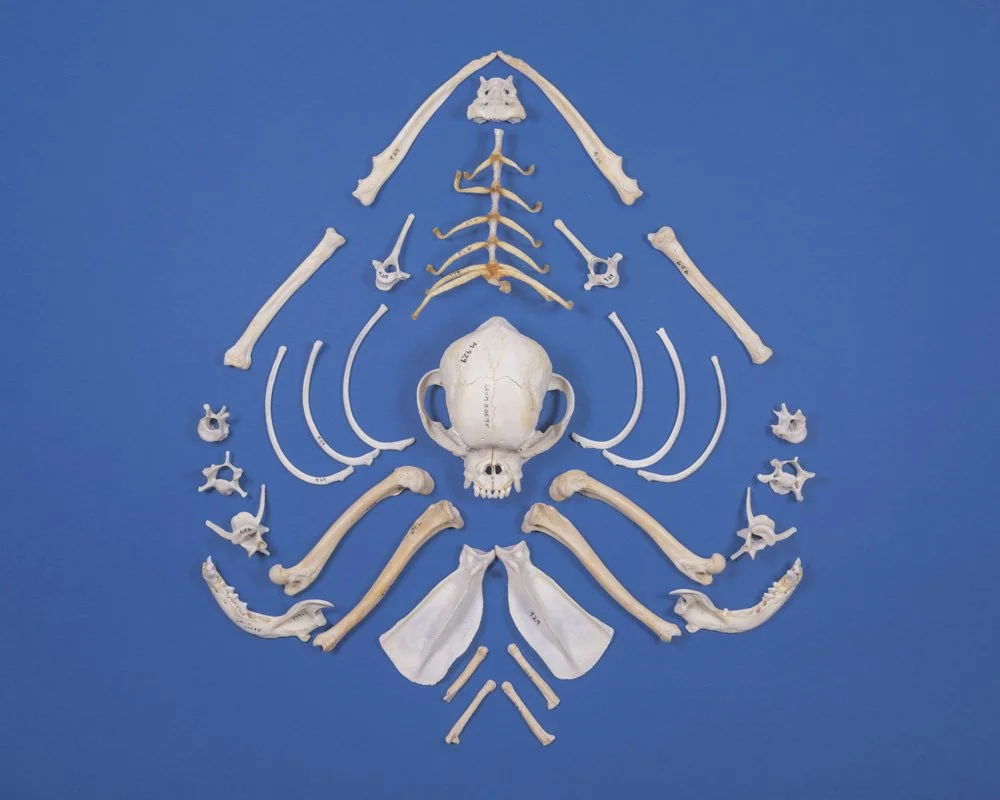
The skeleton of a pug I arranged in a pretty pattern.
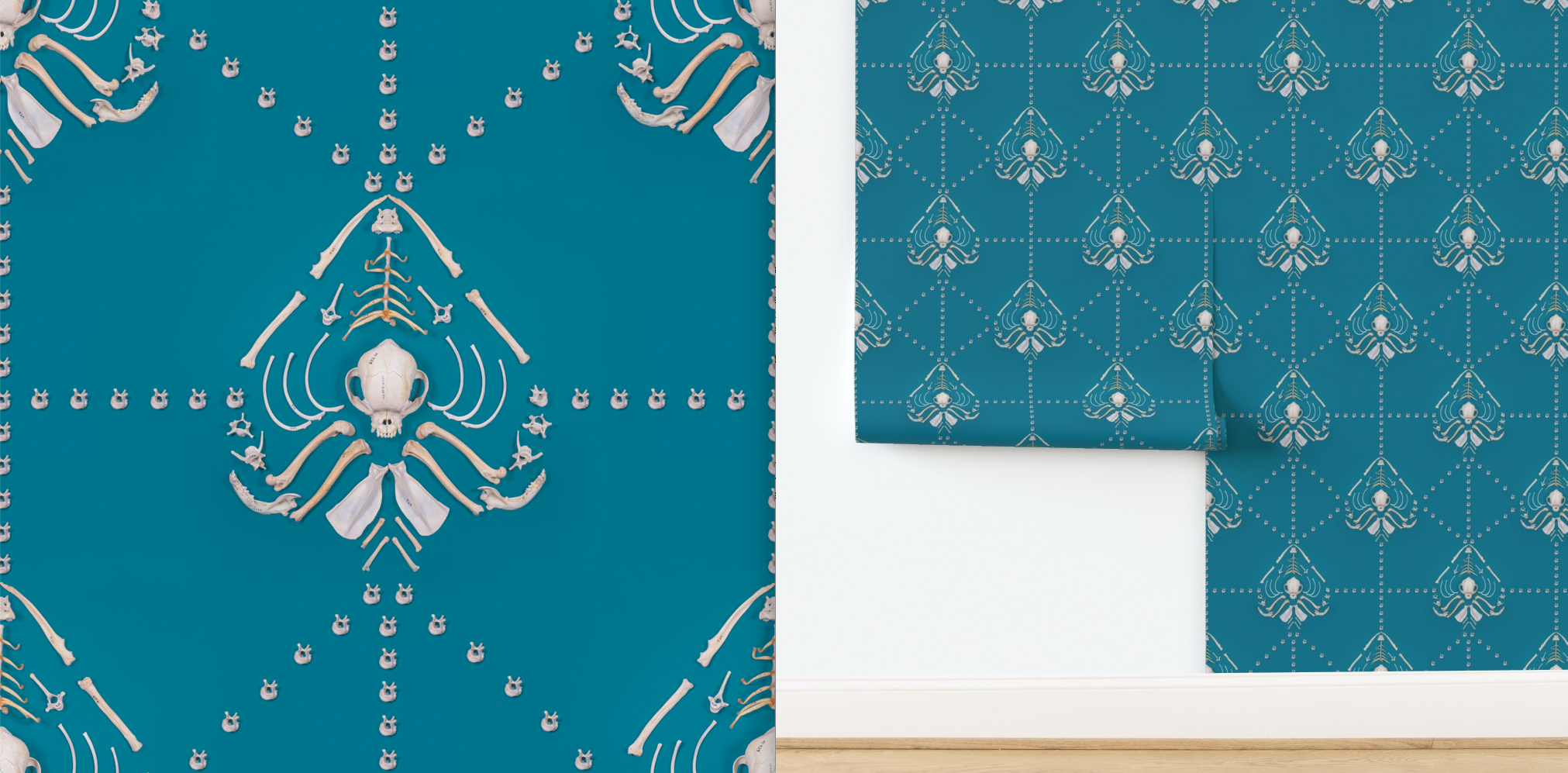
Mock-up of a wallpaper created with the same skeleton.
While I was handling the bones with my blue latex gloves, I started observing the interplay between touching a sacred relic with a scientific, or artistic, interest. Going back to the Lone Woman dogs’ skulls, and wearing my animal chaplain “hat”, I decided to create a series of video performances and photos exploring this juxtaposition. Here, I blur the lines between sacred and scientific, breathing life back into these relics, using religious or caring hand gestures, questioning our relationship to spirituality in a place like the Natural History Museum.
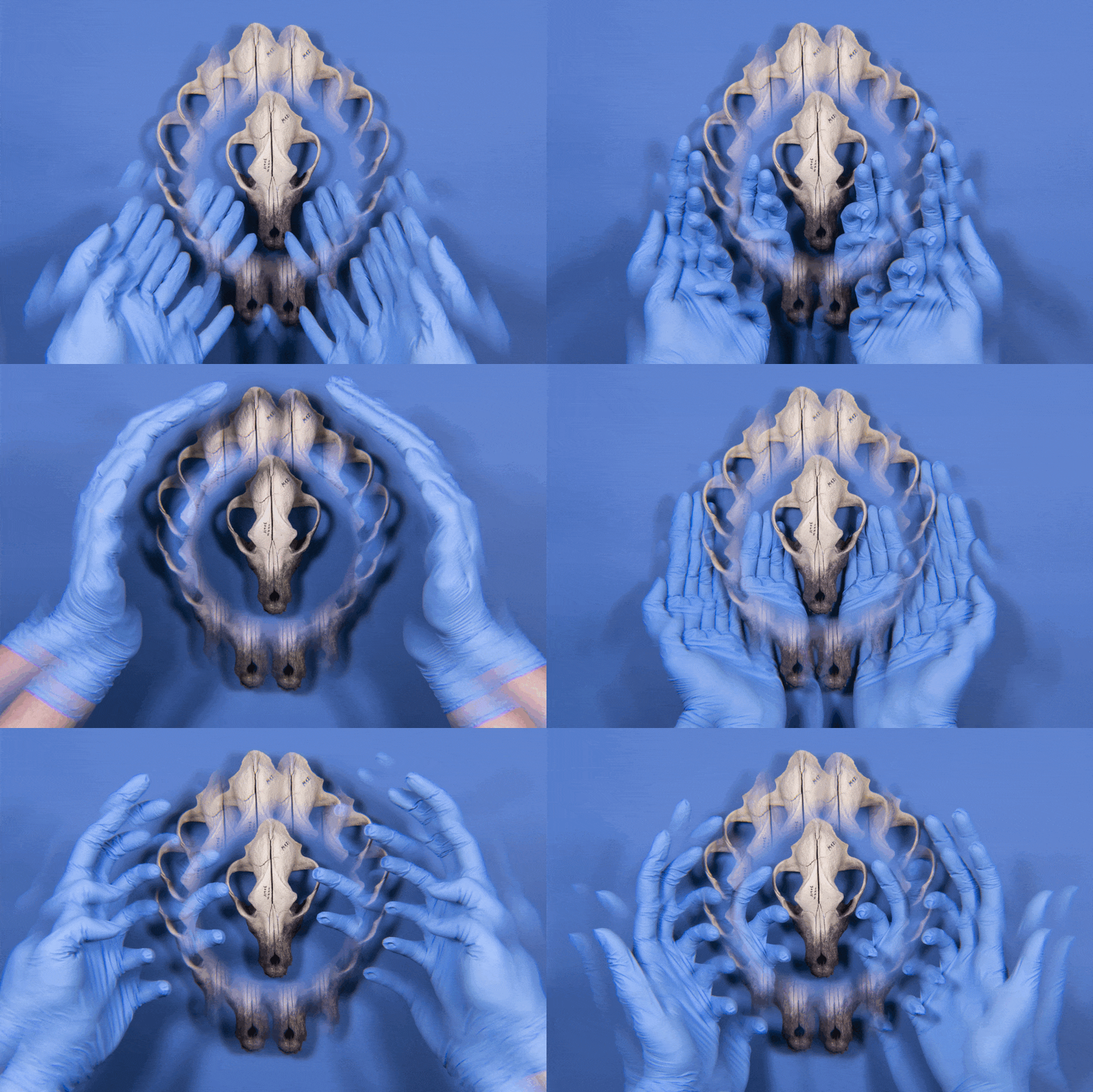
A “hand performance” I created, exploring the handling of sacred objects for science.
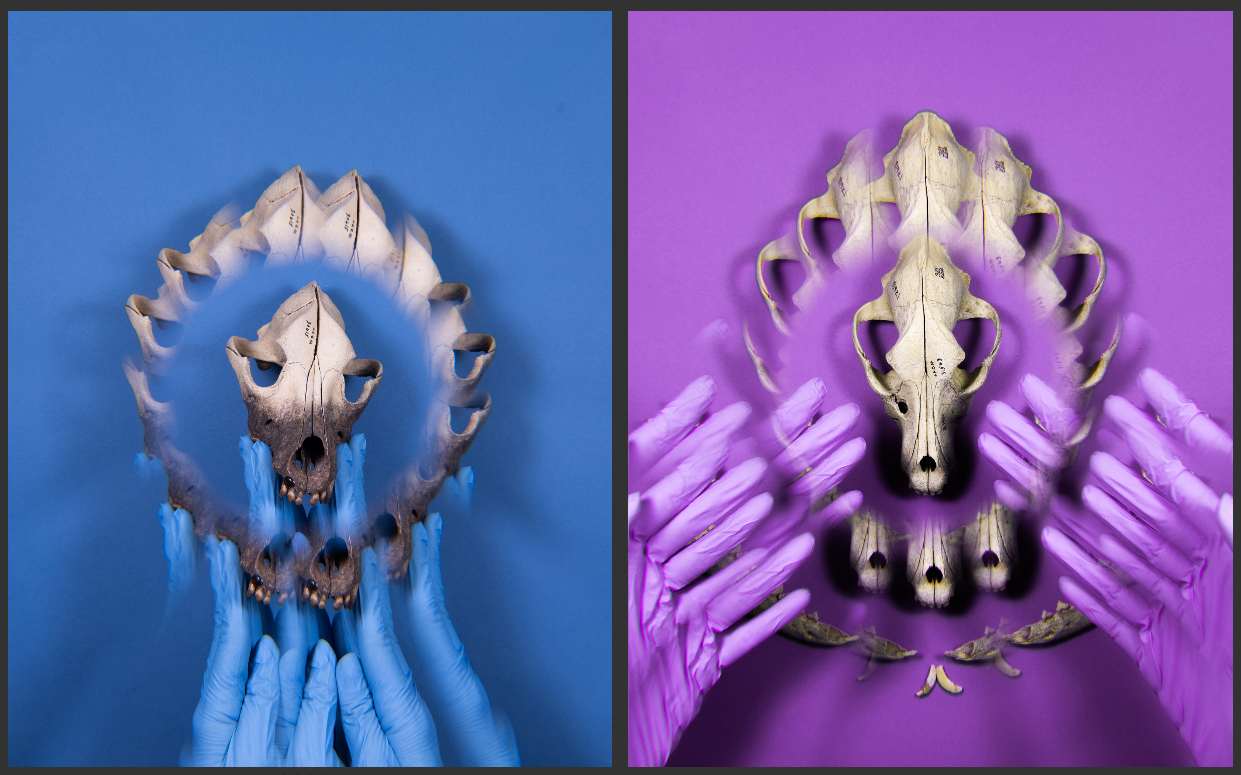
I created a series of saint-like icons.
I would have never been able to create this body of work had I not been in art residency that week. The fact that I had so many hours in that space, forced to sit idle, with the material, forced to let the specimens talk to me and let their stories seep into me so deeply… All that led me to create a body of work I could have never imagined or planned. I have much editing and work to do still, with these images, but I am very excited about them. It makes me marvel at the incredible creative power our brains hold, if we let them wander…
And the best part, is that I was able to have the same experience I would have had at a traditional art residency, except I did not have to wait for a gatekeeper to let me in, I did not have to apply and wait for months for an answer, I didn’t have to pay a fee, I didn’t have to invest thousands of dollars in travel costs, housing, or anything else. All I did was pack a lunch in the morning and take the 30min drive to the museum where a guest pass awaited me. Pinch me!!
Sophie